How to Create a Bilingual Arabic-English Menu for Your Dubai Restaurant
Dubai is home to roughly 3.5 million residents, and a significant share of them speak Arabic as their first language — Emirati nationals, plus large expat communities from Lebanon, Egypt, Syria, Jordan, Saudi Arabia, and across North Africa. Add the millions of GCC tourists who visit every year from Riyadh, Kuwait City, Doha, and Muscat, and you have an enormous dining audience that reads and thinks in Arabic. Yet walk into most restaurants across JBR, Business Bay, or DIFC and you will find a single-language English menu. Some venues offer an Arabic version, but it is often a rough Google Translate job that reads more like a puzzle than a menu. This is a missed opportunity. A properly executed bilingual Arabic-English menu increases covers, raises average order value, and signals the kind of hospitality that keeps diners coming back.
Why Bilingual Menus Matter in Dubai
The business case for a bilingual menu in Dubai is straightforward. Consider who is actually sitting at your tables:
- Emirati nationals — While most speak English fluently, many prefer reading food descriptions in Arabic, especially older family members who drive group dining decisions.
- Arab expat communities — Egyptians, Syrians, Lebanese, Jordanians, and Iraqis make up a substantial portion of Dubai's population. Many are comfortable in English but naturally gravitate towards Arabic text when scanning a menu quickly.
- GCC tourists — Visitors from Saudi Arabia, Kuwait, Bahrain, Qatar, and Oman are among the highest-spending F&B segments in Dubai. Saudi tourists alone spent over AED 20 billion in the UAE in recent years, and a large share of that goes to dining. Many of these visitors are far more comfortable ordering in Arabic.
- Arabic-reading tourists from the wider region — Visitors from Morocco, Tunisia, Iraq, and other Arabic-speaking countries contribute significantly to Dubai's tourism numbers.
Beyond demographics, there is a behavioural factor. When diners can read a dish description in their native language, they are more likely to order confidently — and more likely to order extra items. A diner who cannot fully understand a menu description tends to play it safe, ordering fewer dishes and sticking to what they recognise. A diner who reads a compelling Arabic description of your lamb shank or seafood platter is more likely to add it to the order.
Dubai Municipality has long encouraged bilingual signage across commercial establishments. While menu language is not strictly regulated the way trade names are, the direction is clear: businesses that serve Dubai's diverse population in both official and common languages earn goodwill and repeat custom. For restaurants in areas with heavy Arabic-speaking foot traffic — think Deira, Al Barsha, Jumeirah, or Dubai Mall — a bilingual menu is not a nice-to-have. It is a revenue lever.
The Problem with Paper Bilingual Menus
If bilingual menus are so obviously useful, why do so many restaurants skip them? The answer usually comes down to the practical headaches of producing a printed bilingual menu:
- Double the pages, double the cost. A 6-page English menu becomes a 12-page bilingual booklet. Printing costs climb, and the menu becomes physically bulky — awkward on small tables and expensive to replace when it gets stained or torn.
- RTL layout is genuinely difficult in print. Arabic reads right-to-left. English reads left-to-right. Placing both on the same page without the layout looking chaotic requires a skilled bilingual graphic designer — not just someone who can use InDesign. Many design agencies in Dubai charge AED 3,000–8,000 for a professional bilingual menu layout.
- Translation errors go unnoticed. A restaurant owner who does not read Arabic may not spot a mistranslation for months. By then, hundreds of Arabic-speaking diners have seen a menu item described as something confusing or, worse, unappetising.
- Updates are painful. Change one price or add a seasonal dish, and you need to update both language versions, re-layout the pages, re-proof, reprint, and redistribute. Most restaurants just stop updating the Arabic version, which drifts out of sync with the English menu.
- Many restaurants give up entirely. Faced with these costs and complications, the majority of mid-range restaurants simply go English-only and accept the lost Arabic-speaking revenue. Some add a poorly formatted Arabic PDF as an afterthought, which does more harm than good.
Digital Solves the Bilingual Challenge
Digital menus remove almost every pain point that makes printed bilingual menus impractical. Here is why the format shift matters:
- Separate language layers, same menu structure. A digital menu platform stores your English and Arabic content as two layers of the same underlying menu. Categories, items, and prices are shared — only the text differs. This means you never have two separate documents drifting out of sync.
- RTL rendering handled automatically. A proper digital menu platform detects Arabic text and renders it right-to-left with correct alignment, punctuation placement, and line breaking. You do not need to hire a bilingual designer or worry about layout issues.
- Proper Arabic typography. Arabic text rendered in a Latin-optimised font looks broken — characters fail to connect, diacritics float in the wrong place, and the text feels amateur. Digital platforms use dedicated Arabic typefaces (such as Almarai or Cairo) that render beautifully on any device.
- Instant updates in both languages. Change a price from AED 55 to AED 65, and it updates across both language versions immediately. Add a new dish with its English and Arabic description, and it goes live the same day. No reprinting, no waiting for deliveries.
- Zero extra cost. With a digital menu, adding Arabic does not add pages or printing costs. The bilingual capability is built into the platform. If you already have a free digital menu, adding Arabic is a configuration step, not a budget line item.
- QR code access. Diners scan a single QR code and the menu loads in their preferred language, either automatically based on their phone settings or via a simple language toggle. No need for separate QR codes or separate printed menus.
Common Translation Mistakes to Avoid
Whether you handle Arabic translations yourself or use a platform that provides them, knowing the common pitfalls helps you spot problems before your diners do:
1. Relying on Google Translate for food terms
Machine translation struggles with culinary vocabulary. "Mixed grill" might come back as a literal translation that sounds like you are mixing grills together rather than serving a platter of grilled meats. "Caesar salad" is a proper noun — it should be transliterated, not translated. Google Translate does not reliably know the difference.
2. Translating dish names that should be transliterated
Some dish names are universally recognised in their original language and should simply be written in Arabic script phonetically: sushi, pizza, burger, pasta, risotto. Attempting to translate these into descriptive Arabic phrases confuses diners who know exactly what a burger is.
3. Translating dish names that should actually be translated
On the other hand, generic descriptive dishes should be properly translated: grilled chicken, lentil soup, mixed rice. Arabic-speaking diners expect to read these in natural Arabic, not as transliterated English words.
4. Word-for-word literal translations
English menu descriptions often use a style that does not work in direct Arabic translation. "Pan-seared salmon fillet on a bed of wilted spinach with a lemon beurre blanc" translated word-for-word into Arabic reads unnaturally. A skilled Arabic food writer would restructure this as a natural Arabic sentence that conveys the same dish appealingly.
5. Using Modern Standard Arabic when Gulf dialect is more appropriate
Your diners in Dubai are primarily Gulf Arabic speakers or Levantine Arabic speakers. Using overly formal Modern Standard Arabic (fusha) in menu descriptions can feel stiff — like reading a news broadcast instead of a menu. The tone should be clear and accessible, using food terminology that resonates with how people in the Gulf actually talk about food.
6. Skipping the native speaker review
No matter how the translation is produced, have a native Arabic speaker — ideally someone familiar with Gulf food culture — read through the entire menu before it goes live. They will catch awkward phrasings, incorrect transliterations, and descriptions that simply do not sound appetising in Arabic.
How Places UAE Handles Bilingual Menus
Places UAE provides bilingual Arabic-English menus as a core feature of its free digital menu for restaurants. Here is how it works in practice:
- Professional Arabic content. Menu descriptions are written by native Arabic speakers with food industry experience — not auto-translated by a machine. The result reads naturally and appetisingly in Arabic.
- Proper RTL rendering. Arabic text is displayed right-to-left with the Almarai typeface, purpose-built for Arabic digital readability. Characters connect correctly, diacritics sit where they should, and line breaks happen at natural word boundaries.
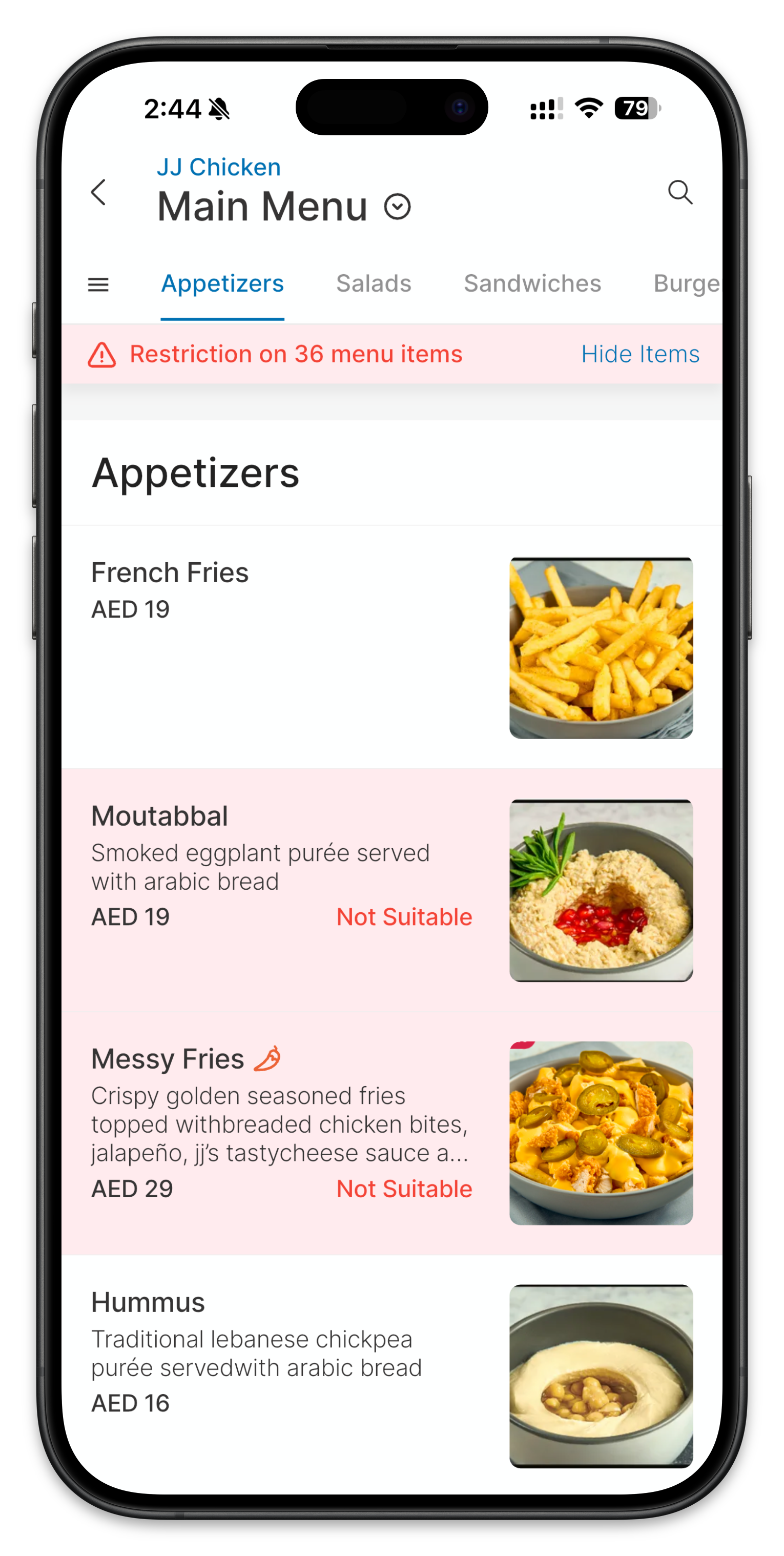
- Food photos as universal language. Every menu item can include a photo, which works alongside both Arabic and English text. A diner browsing in either language sees the same image, reinforcing their understanding of the dish. This is especially valuable for restaurants serving cuisines that may be unfamiliar — whether it is a Lebanese restaurant with dishes an East Asian tourist has not tried, or a Japanese restaurant with items a Gulf tourist wants to explore.
- Allergen and dietary tags in both languages. Dietary labels — including halal certification, vegetarian, vegan, gluten-free, and nut-free — display correctly in both Arabic and English. This is critical for diners with allergies who need to understand ingredient information clearly in their own language.
- Single update process. Restaurant owners update their menu once. The platform ensures both language versions stay synchronised. No duplicate spreadsheets, no forgotten Arabic updates, no version mismatches.
- Completely free. Arabic language support is included at no extra charge. There is no premium tier required for bilingual menus, no per-language fee, and no translation surcharge.
Restaurants across Dubai are already on Places UAE, and the platform's bilingual infrastructure means every one of those menus can serve Arabic-speaking diners without additional effort from the restaurant.
Tips for Writing Great Arabic Menu Descriptions
Whether you are writing Arabic descriptions yourself or reviewing translations someone else produced, these guidelines will help you get better results:
- Keep descriptions concise. Arabic naturally uses more words than English to express the same idea. If your English description is already long, the Arabic version will be longer. Aim for tight, appetising descriptions — two lines maximum per item.
- Lead with the main protein or star ingredient. Arabic food culture places high importance on the main ingredient. Grilled chicken tells the diner what they need to know immediately. Supporting ingredients and sauces come second.
- Mention the cooking method. Grilled, fried, baked, slow-cooked — Arabic-speaking diners pay close attention to preparation methods, especially for meat dishes.
- Use flavour descriptors from Arabic food culture. Words that convey marinated, fresh, charcoal-grilled, and with saffron resonate immediately with Arabic-speaking diners. These carry cultural weight that generic translations miss.
- Avoid Western culinary jargon that does not translate. Terms like "deconstructed," "foam," "reduction," and "coulis" have no natural Arabic equivalents. Either describe what the element actually is (a light sauce, a whipped cream, a concentrated broth) or leave the term out entirely.
- Match the tone to your restaurant. A casual shawarma shop in Karama and a fine-dining restaurant in DIFC should not use the same register of Arabic. Casual venues can use colloquial, friendly phrasing. Upscale venues should use polished but still accessible language.
Frequently Asked Questions
Do I need to provide the Arabic translation myself?
No. Places UAE handles Arabic menu content with native Arabic speakers who understand food terminology and Gulf dining culture. You provide your menu in English, and the platform takes care of producing a natural, accurate Arabic version. If you already have professional Arabic translations you are happy with, those can be used instead.
What if my restaurant serves non-Arabic cuisine?
A bilingual menu is valuable regardless of your cuisine type. Arabic-speaking diners in Dubai eat every cuisine — Japanese, Italian, Indian, Thai, Mexican, and everything in between. A Kuwaiti family dining at an Italian restaurant in Dubai Marina still wants to read dish descriptions in Arabic. The cuisine you serve does not determine the language your customers prefer to read.
Can I add a third language beyond English and Arabic?
Places UAE natively supports English and Arabic with full RTL rendering and proper typography for both. If you need additional languages — Mandarin, Russian, Hindi, or others — contact the Places UAE team to discuss options. The digital platform architecture supports multilingual content, and additional languages can be accommodated for venues with specific requirements.
How long does it take to get my menu live in both languages?
Most restaurants have their bilingual digital menu live within a few days. The English version can go up immediately. Arabic translation and review typically adds one to three working days depending on menu size. Once both versions are live, updates to either language happen in real time.
Making Bilingual Work for Your Restaurant
A bilingual Arabic-English menu in Dubai is not a luxury or a cultural gesture — it is a practical business decision that directly affects how many people order from your menu and how much they spend. The Arabic-speaking market in Dubai and the wider GCC is too large and too valuable to serve with an English-only menu or a sloppy translation.
Digital menus have removed the cost and complexity barriers that made bilingual print menus impractical. With Places UAE, adding professional Arabic support to your menu is free, fast, and maintained automatically. Your English and Arabic menus stay in sync, render beautifully on any device, and reach diners who are already using Places to choose where to eat in Dubai.
If you have not set up your digital menu yet, start with the free digital menu guide. If you already have a digital menu and want to ensure your Arabic version is up to standard, review the translation tips above and reach out to the Places UAE team for a bilingual menu audit at no cost.
Get Your Free Digital Menu on Places UAE
Join the Places cashback network and your digital menu is included. No subscription.
Get Your Free Digital Menu